The bag with a handle, 5 kg
Pellets for your stove, in Hautrage
Five kilos, a handle moulded into the plastic, like a water jerrycan. It does not exist anywhere else.
Ask for a price, bags and pallets- 5 kgthe bag with a handle, carried in one hand
- +36%heating oil in three and a half weeks, July 2026
- +12.9%pellets over twelve months, ValBiom reading
Class A1 pellet, ISO 17225-2 standard. It turns as you scroll down the page.
- 6 mmDiameterThe size your stove expects. A pellet that is larger, or bent, and it is the auger that jams, one January evening.
- <10%Moisture contentA pellet that has taken on water swells, crumbles and burns less well. It is the first figure I check when a truck arrives.
- ≤ 0.7%Ash contentThat is your ash pan. Twice the ash means emptying it twice as often, and more chance of finding clinker stuck in the burn pot.
- ≥ 97.5%Mechanical durabilityA durable pellet does not break in transit. If it is friable, you find sawdust at the bottom of the bag and dust in the hopper.
- ≥ 4.6 kWhCalorific value per kiloWhat the bag actually heats. Two pallets at the same price will not give you the same winter, and it shows in bags burned.
Prices, as of 29 July 2026
Heating oil rose 36% in three and a half weeks. Pellets, 12.9% in a year.
On 1 July, the legal maximum price of heating oil was 1.0005 euro per litre. On the 25th, 1.3638. Careful with that word, maximum: it is a ceiling, not a price, and the same day some sellers were 6% below it. The speed, though, is very real, and it has nothing to do with taxes. It comes from the war on Iran, and a barrel that has crossed one hundred dollars three times since February.
The price is written here. You do not have to phone to find out.
Getting a pellet price usually means calling, leaving your name and number, and waiting for a salesperson to ring back. Here is ours, updated with every lot.
| What you are taking | Format | Price |
|---|---|---|
| A pallet | 65 bags of 15 kg, roughly one tonne | €700 including VAT |
| Several pallets | Tiered from the second pallet, delivered or collected | Tiered, priced within 24 hours |
| Professional reseller | Heating engineer, shop, sole trader, farmer | From €480 excluding VAT |
Why this price can move
Because a price posted in July would be wrong by October. Pellets follow a market, and the autumn rise comes back every year. This one is today's price, dated. The price we send you on the quote, though, is fixed and held until the date shown on it.
Prices include VAT for a private customer, at the 6% rate that applies to wood pellets. Trade terms are quoted excluding VAT. The price delivered to your door is written on the quote, with its date.
Transport depends on your postcode and the number of pallets. It is priced separately, never hidden in the price of the bag. Collect in Hautrage, and there is none. For a single bag, 5 kg with a handle or 15 kg, ask for the price: it follows the current lot.
What you keep, worked out honestly
We do not compare a litre to a kilo, we compare heat in your home to heat in your home. A litre of heating oil gives 10 kWh, the convention used by the Walloon PEB energy guide. A kilo of certified pellets gives at least 4.6 kWh, guaranteed by the ISO 17225-2 standard. Then we divide by the appliance's efficiency: 95% for a condensing oil boiler, 85 to 88% for a pellet stove. You now have everything you need: today's heating oil price is further up this page, ours is in the table just above, and you know your own consumption better than we do. Multiply, and you will have your own figure rather than a typical bill we would have invented for you. And the single bag bought in a supermarket, heat for heat, is barely cheaper than heating oil, sometimes the same: that, we will not sell you as an argument.
And what we owe you straight, regardless
Pellets are ahead today because heating oil is on a war spike. In June 2026, heating oil averaged 1.0491 euro per litre: at that level, only well bought pellets, by the pallet or in bulk, stay ahead. In July 2025, it was 0.8211, and pellets were not cheaper at all then. So the argument is not that pellets are cheaper, full stop. It is that they are far steadier: a 36% rise for heating oil in three and a half weeks this month, 12.9% for pellets in twelve months. The barrel has in fact already dropped from 91.68 to 85.41 dollars between 27 and 28 July. It is not the same kind of risk, and that is what you are buying.
All figures include VAT and were checked on 29 July 2026: official FPS Economy prices for heating oil, ValBiom's monthly reading for the 15 kg bag. The heating oil price changes almost daily, the pellet price once a month. If you are reading this page later, ask us for today's figures, we will send them.
The 5 kg bag
A bag you grab with one hand, like a water jerrycan
Fifteen kilos, you take it in both hands, rest it on your knee, and swear once you reach the stove. It is the format almost everyone sells. The smaller format already exists, in 8 kg and 10 kg, in France as in Belgium. But a plastic pellet bag with a handle does not exist anywhere. A Swedish producer did launch a handled carton in 2020, and won an award for it, but nothing has been heard of it since.
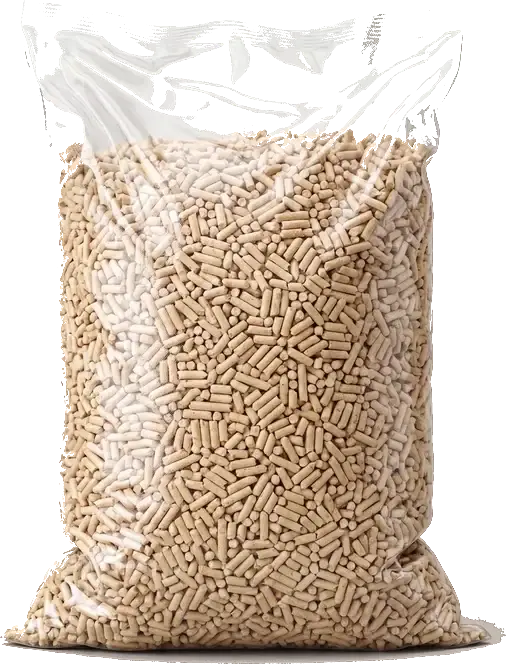

When five kilos change something
When the stove is upstairs and the stock is in the cellar. Mid season, when you burn three bags a month, not three a week. When it is your seventy five year old mother feeding the stove every day. And when you walk back from the shop with enough for the week.
The fifteen kilo bag is not going anywhere, and the five kilo one does not replace it: you buy the pallet for the winter, and a few 5 kg bags alongside it, for upstairs and for mid season. It costs a little more per kilo, like all small formats. One solid reference point: with a French seller, same brand and delivery, the 8 kg bag costs 4.9% more per kilo than the 15 kg bag (checked on 29 July 2026).
What you cannot see before opening the bag
You pay for a full pallet without seeing a single pellet.
Every summer, the same routine. Two or three phone calls, a price per tonne, and you order from whoever delivers first. The pallet arrives, stays under its wrap in the garage, and you open the first bag in October.
Then there is the year it goes wrong. The stove glass fogs up within two days. The burn pot fills with a hard lump you have to break up, the dreaded clinker. There is sawdust at every level of the bag. You clean more often, heat less, and you are left with sixty bags to burn.
It is not the extra ten euros on the pallet that bothers you. It is paying in July without knowing what you will be burning in January.
The lot report
Every truck has a number. Every number has its analysis.
A lot is a truckload. Before it goes on sale, it goes through four steps, and you can read all four.
- 01
We say who made it
The producer's name, town, country and certification. Not 'wood from Eastern Europe', an actual address.
- 02
We have the lot tested
A sample goes to the laboratory. Moisture, ash, mechanical durability, fines, calorific value per kilo.
- 03
We publish the analysis
Here, on this page, with the lot number and the date. You read it before ordering, not after.
- 04
The number stays on your pallet
It is written on the delivery note. If a bag gives you trouble, we know which truck it came from.
It costs nothing but a bit of rigour. That is exactly why almost no one does it.
The numbers on the bag, made plain
Only one figure really separates A1 from A2
The ISO 17225-2 standard sorts pellets into A1, A2 and B, and that is the letter you see on the bag, next to the ENplus or DINplus logo. Between A1 and A2, moisture, mechanical durability and calorific value per kilo meet the same threshold: that is not where the difference lies. Only one figure really changes, and here is what it does at your end once the bag is emptied into the hopper.
| What is measured | Class A1 | Class A2 | What it changes at your end |
|---|---|---|---|
| Ash content | 0.7% maximum | 1.2% maximum | Your ash pan. Twice the ash means emptying it twice as often. It is also where clinker forms, when hardwood and bark end up in the mix. |
What stays the same between the two classes
Three thresholds are exactly the same in A1 and A2. That is not an oversight: it is precisely what makes the gap on ash so meaningful, since it is the only figure that changes from one class to the other.
Moisture content, under 10% in both classes. A pellet that has taken on water swells and crumbles. It is the main reason for a bag with sawdust at the bottom.
Mechanical durability, at least 97.5% in both classes. Its resistance to breaking during transport. Below that, it turns to dust, and the auger eventually jams.
Calorific value, at least 4.6 kWh in both classes. What the bag actually heats. Two pallets at the same price will not give you the same winter.
We sell class A1. The lot report gives the values measured on the truck, not the maximum limits the standard allows.
The lot report
The current lot
The first report will appear here
The season has not started yet. As soon as the first truck is unloaded and the sample analysed, the full report appears on this page: the lot number, the date, the laboratory and the five measurements. Leave your address and we will let you know the day it comes out.
Let me know when the truck arrivesQuestions we get asked
- I do not know you. Why would I buy from you?
- Start small. We send you a sample, you burn it, you check the ash pan and the glass. Then a few bags, then a pallet if you liked it. No one is asking you to order your whole winter from someone you have never heard of.
- Are Ukrainian pellets any good?
- Some are very good, some are not, like anywhere, Belgium included. That is exactly why we publish the analysis of every truck instead of selling you a country. What makes the quality is the mill and the checks, not the border. We give you both names.
- What if there are none left this winter?
- That is a real fear, and a fair one: in 2022, plenty of people could not find a supplier right when they needed one. We do not want to depend on a single country. Romania and the Baltic states produce as well, and we have contacts there. If one border closes, we change supplier, not business.
- Are you cheaper than the supermarket?
- By the single bag, no, and honestly no one really is. What sets the price of pellets is not the pellet itself, it is the packaging and the transport: on 29 July 2026, the same product ranged from 350 euros a tonne delivered by the pallet to 533 euros a tonne bought by the single bag in a supermarket. It is by the pallet that we are worth comparing, and it is by the pallet that you should compare us.
- Should I order now or wait until September?
- Pellets are usually at their lowest in summer and climb again as winter starts: in 2025, the 15 kg bag went from 5.43 euros in July to 5.86 in November, a 7.9% rise, roughly 28 euros on a pallet of 65 bags (ValBiom reading). This year the summer dip did not happen, the curve has been climbing since January. So I am not going to sell you a summer drop that does not exist. What I can say is that the autumn rise comes back every year.
- Can I see it before I buy?
- Yes. We send a free sample, and you can come and see the stock in Hautrage. It is ten minutes from the E42, there is room to park, and we will put a 5 kg bag in your hand so you can lift it yourself.
Your price within 24 hours
The number of bags or pallets, your postcode, and whether you want the 5 kg bag. You get a dated range and the analysis of the current lot.
Ask for bag pricesNo lengthy form. Five fields, and someone from the warehouse answers you.